First-Time Home Buyer Checklist for Canada
Buying your first home in Canada comes down to ten steps. Most of the stress comes from doing them in the wrong order, for example house-hunting before you know your real budget, or finding out about closing costs a week before closing. Here is the order that works.
The 10 steps, in order
- Find your comfortable budget, not the bank's maximum. Lenders approve up to about 39% of your income for housing costs and 44% for all debts. That's a ceiling, not a plan. Start from what you can pay in a bad month. Work out what you can afford.
- Know your minimum down payment. It's 5% of the first $500,000, then 10% of the rest up to $1.5 million. Calculate yours.
- Use the government accounts. A First Home Savings Account (FHSA) and the RRSP Home Buyers' Plan can be combined. FHSA vs HBP explained.
- Check and fix your credit. Pull your free credit reports from Equifax and TransUnion three to six months before you apply, and fix any errors.
- Add up your cash to close. On top of the down payment, plan for 1.5% to 4% of the price in closing costs, in cash. Estimate your closing costs.
- Get pre-approved and compare lenders. A pre-approval holds a rate, usually for 90 to 120 days. Compare offers on total cost (rate, penalties, prepayment options), not just the rate.
- Tour homes with a scorecard. Score every home on the same things: commute, condition, monthly costs and resale.
- Make a conditional offer. Keep conditions for financing and a home inspection unless you have a very good reason not to.
- Prepare for closing day. Book a lawyer or notary early, arrange home insurance (your lender will ask for proof), and confirm the exact amount to wire with your lawyer by phone.
- Plan your first year. Set aside 1% to 3% of the home's value every year for maintenance, and keep an emergency fund.
Documents to gather before you apply
- Two recent pay stubs and a job letter (or two years of tax returns if self-employed)
- Your last two years of Notices of Assessment from the CRA
- 90 days of statements for every account your down payment comes from
- A signed gift letter if family is helping with the down payment
- Photo ID and a void cheque
Mistakes that cost first-time buyers the most
- Taking on new debt before closing. A car loan or new credit card can cancel your approval at the last minute.
- Moving money around without a paper trail. Lenders want to see where your down payment came from for the last 90 days.
- Waiving the inspection to win a bidding war. A $500 inspection can save a $15,000 surprise.
- Forgetting closing costs. They're due in cash and usually can't be added to the mortgage.
Want the whole plan, with your own numbers?
The toolkit's Start Here Roadmap turns these 10 steps into a plan, with the guide and calculator to use at each stage.
Common questions
Who counts as a first-time home buyer in Canada?
For most federal programs (FHSA, Home Buyers' Plan, the first-time buyers' tax credit), you qualify if you haven't lived in a home you or your spouse owned in the current year or the previous four calendar years. Provincial rebates have their own rules; Ontario and BC, for example, require that you have never owned a home anywhere.
How long does it take to buy a first home?
From pre-approval to keys, often two to four months. Closing usually happens 30 to 90 days after your offer is accepted.
How much money do I need to buy my first home?
The minimum down payment (5% on a home up to $500,000) plus 1.5% to 4% of the price for closing costs. On a $450,000 home that's $22,500 plus about $7,000 to $18,000.
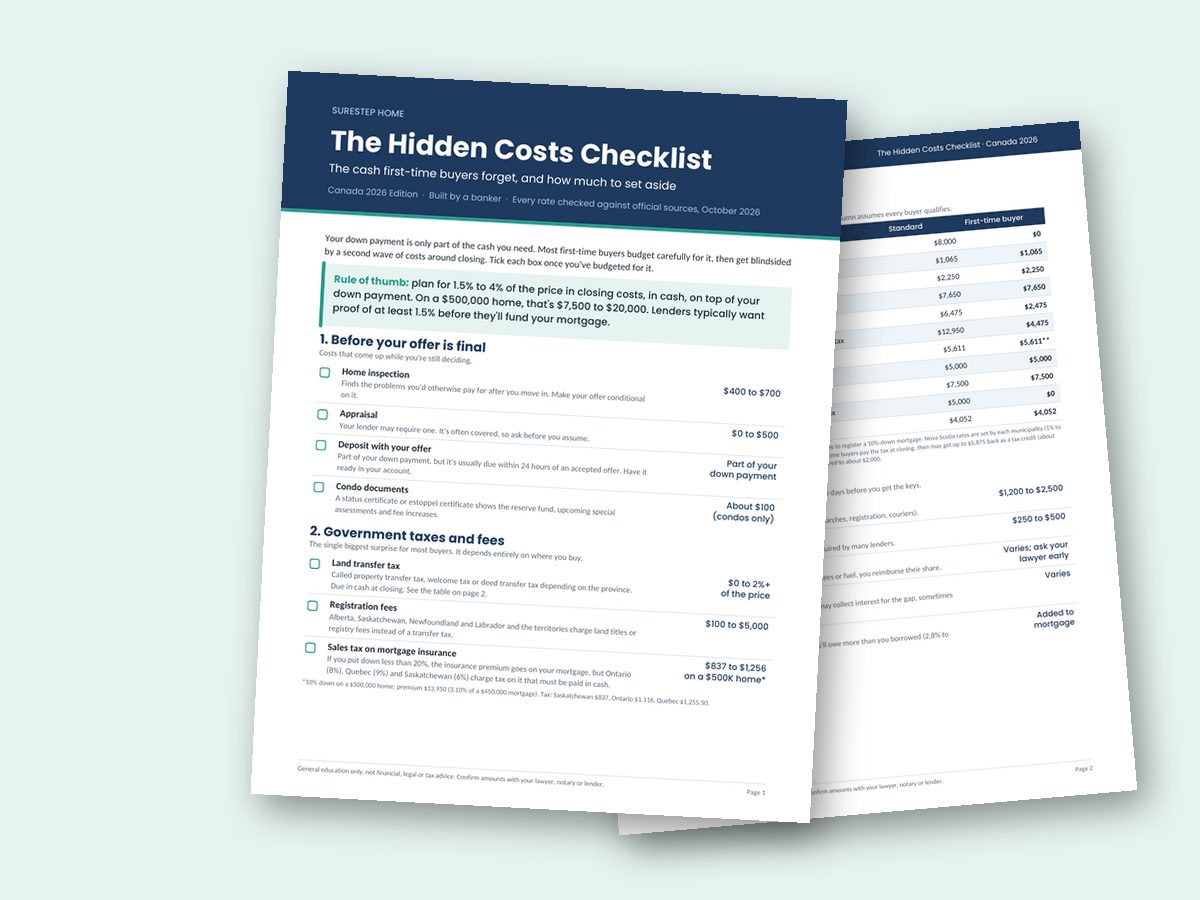
Free: the Hidden Costs Checklist
The 22 costs first-time buyers forget, with a typical price for each, plus the land transfer tax for every province on a $500,000 home.
Send me the free checklistMore free guides
- Closing Costs in Canada: How Much Cash You Need
- Land Transfer Tax in Canada, Province by Province
- Minimum Down Payment in Canada
- How Much Does CMHC Mortgage Insurance Cost?
- The Mortgage Stress Test, Explained
Sources
General education only, not financial, legal, tax or mortgage advice. Rules change; confirm amounts with your lender, lawyer or notary before you rely on them.